Maximize Your 2025 Education Tax Credits: Save Up To $2,500

Understanding and applying for education tax credits in 2025 is crucial for eligible taxpayers to significantly reduce their federal income tax liability, potentially saving up to $2,500 on qualified educational expenses.
Are you or a loved one planning for higher education expenses in 2025? Understanding how to maximize your education tax credits 2025 can lead to substantial savings, potentially putting up to $2,500 back into your pocket. This guide will walk you through the essential credits and strategies to ensure you don’t leave money on the table.
Understanding the Landscape of Education Tax Credits
Navigating the complex world of tax credits can feel daunting, especially when it comes to educational expenses. However, for students and their families, these credits represent a significant opportunity to offset the rising costs of tuition, fees, and related educational outlays. The Internal Revenue Service (IRS) offers several provisions designed to alleviate this financial burden, primarily through two key tax credits: the American Opportunity Tax Credit (AOTC) and the Lifetime Learning Credit (LLC). Each credit serves a distinct purpose and has specific eligibility requirements, making it crucial to understand which one best fits your situation for 2025.
Choosing the right credit can make a substantial difference in your tax return. While you cannot claim both credits for the same student in the same tax year, understanding their nuances allows you to select the most beneficial option. The AOTC, for instance, is often more generous for undergraduate students, while the LLC provides broader flexibility for various educational pursuits, including graduate studies and skill development. Careful planning and record-keeping are paramount to successfully claim these valuable benefits.
The American Opportunity Tax Credit (AOTC)
The AOTC is a partially refundable credit that can provide a maximum annual credit of $2,500 per eligible student. This credit is specifically designed for students pursuing a bachelor’s degree or other recognized post-secondary educational credential. It’s available for the first four years of higher education, offering a robust financial incentive for undergraduate studies.
- Eligibility: Student must be pursuing a degree or other recognized educational credential, enrolled at least half-time for at least one academic period beginning in the tax year, and not have completed the first four years of higher education.
- Qualified Expenses: Includes tuition, required fees, and course materials (books, supplies, equipment) needed for enrollment.
- Credit Amount: 100% of the first $2,000 of qualified education expenses and 25% of the next $2,000 of qualified education expenses.
The refundable portion of the AOTC means that if the credit reduces your tax liability to zero, you could still receive up to 40% of the remaining credit (up to $1,000) as a refund. This feature makes the AOTC particularly attractive for lower-income families or students with minimal tax liability, providing direct financial assistance. However, income limitations apply, so taxpayers with higher modified adjusted gross incomes (MAGI) may find their credit phased out or eliminated.
The Lifetime Learning Credit (LLC)
The Lifetime Learning Credit offers a maximum non-refundable credit of $2,000 per tax return. Unlike the AOTC, the LLC is not limited to undergraduate studies or the first four years of college. It’s a versatile credit that can be claimed for courses taken to acquire job skills, for graduate-level studies, or even for a single course at an eligible educational institution. This flexibility makes it a valuable option for lifelong learners and those pursuing continuing education.
- Eligibility: Student is taking courses toward a degree or to acquire job skills, and enrolled at an eligible educational institution. No enrollment level requirements.
- Qualified Expenses: Includes tuition and required fees. Course materials are only included if required for enrollment and purchased from the institution.
- Credit Amount: 20% of the first $10,000 of qualified education expenses.
The LLC is claimed per tax return, not per student, meaning even if multiple students in a household incur qualified expenses, the maximum credit remains $2,000. It’s important to note that the LLC is non-refundable, so it can reduce your tax liability to zero but will not result in a refund beyond that. Income limits also apply to the LLC, similar to the AOTC, which can affect eligibility and the amount of credit received. Understanding these differences is key to optimizing your education tax credits for 2025.
Eligibility Requirements: Who Qualifies for What?
Determining eligibility for education tax credits is the first critical step toward maximizing your savings. Both the American Opportunity Tax Credit (AOTC) and the Lifetime Learning Credit (LLC) have specific criteria that must be met by the student, the educational institution, and the taxpayer claiming the credit. These requirements ensure that the credits are applied as intended, supporting legitimate educational pursuits and financial relief.
It’s vital to review these conditions carefully each tax year, as they can sometimes be adjusted by legislative changes. For 2025, understanding the income thresholds, enrollment status, and prior education history is particularly important. Failing to meet even one criterion could result in the denial of the credit, so meticulous attention to detail is essential for a successful claim.
Student Eligibility for AOTC
The AOTC is quite specific about who can claim it. The student must be pursuing a degree or other recognized educational credential. This typically means enrollment in a program that leads to a certificate, associate’s, or bachelor’s degree. Furthermore, the student must be enrolled at least half-time for at least one academic period beginning in the tax year. This half-time enrollment status is a key differentiator from the LLC, which has no such requirement.
- Degree Program: Must be for a program leading to a degree, certificate, or other recognized educational credential.
- Enrollment Status: At least half-time for at least one academic period beginning in the tax year.
- Years of Study: Available only for the first four years of post-secondary education.
- Felony Drug Convictions: The student cannot have a felony drug conviction on their record at the end of the tax year.
These strict requirements ensure the AOTC primarily benefits those undertaking traditional, full-time undergraduate education. It’s a substantial benefit, but its narrow scope means not all students will qualify. Parents claiming a dependent student, or independent students themselves, must confirm all these conditions are met. 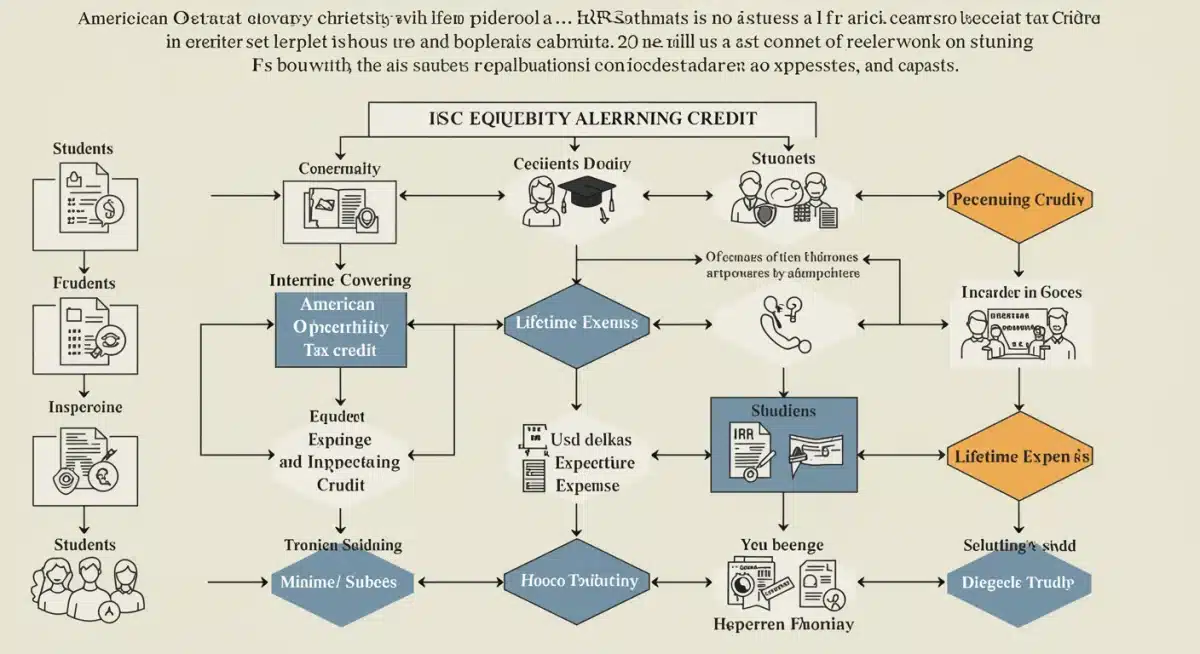
Student Eligibility for LLC
The Lifetime Learning Credit offers much broader eligibility, making it suitable for a wider range of educational scenarios. There is no requirement for the student to be pursuing a degree or to be enrolled at least half-time. This flexibility means the LLC can be used for individual courses, professional development, or even for graduate studies. It’s an excellent option for those looking to enhance their skills or pursue higher education later in life.
- Educational Purpose: Courses taken to acquire job skills or for undergraduate, graduate, or professional degree programs.
- Enrollment Status: No minimum enrollment level required; even a single course can qualify.
- Years of Study: No limit on the number of years the credit can be claimed.
The LLC’s less restrictive student eligibility makes it a go-to option when the AOTC is not applicable. It’s important to remember that while the LLC is more flexible, it is a non-refundable credit, and its maximum amount is lower than the AOTC. For taxpayers seeking to offset educational expenses beyond the first four years of undergraduate study, or for those enrolled in non-degree programs, the LLC provides crucial support. Both credits also have income limitations for the taxpayer claiming them, which we will discuss next.
Income Limitations and Phase-Outs for 2025
While education tax credits offer significant financial relief, their availability and maximum amounts are often tied to specific income thresholds. For 2025, it’s crucial to understand the Modified Adjusted Gross Income (MAGI) limits that determine whether you can claim the American Opportunity Tax Credit (AOTC) or the Lifetime Learning Credit (LLC), and if so, how much of the credit you are eligible for. These income limitations are put in place to ensure that the tax benefits are directed towards families and individuals who need them most.
The IRS regularly adjusts these income thresholds for inflation, so what applied in previous years might be slightly different for 2025. Staying informed about these figures is essential for accurate tax planning and avoiding unexpected credit reductions. Navigating these phase-outs correctly can be the difference between receiving the full credit and receiving a reduced amount, or none at all.
AOTC Income Limits
For the AOTC, the credit begins to phase out for taxpayers with a Modified Adjusted Gross Income (MAGI) above a certain amount, and it is completely eliminated once MAGI reaches an upper limit. These thresholds apply to both single filers and married couples filing jointly, though the amounts differ. For 2025, it’s projected that the AOTC phase-out will begin for single filers with MAGI above approximately $80,000 and be completely phased out at around $90,000. For married couples filing jointly, the phase-out typically starts at roughly $160,000 and is fully phased out at about $180,000.
- Single Filers: Phase-out begins around $80,000 MAGI, fully phased out around $90,000 MAGI.
- Married Filing Jointly: Phase-out begins around $160,000 MAGI, fully phased out around $180,000 MAGI.
These figures are estimates and subject to final IRS guidance for the 2025 tax year. It’s important to consult official IRS publications or a tax professional for the most accurate and up-to-date information. Understanding where your MAGI falls within these ranges is critical, as it directly impacts the amount of AOTC you can claim. Even if your MAGI is within the phase-out range, you might still qualify for a partial credit, which can still be a significant financial benefit.
LLC Income Limits
The Lifetime Learning Credit also has its own set of income limitations, which are generally lower than those for the AOTC. This means that individuals or families with higher incomes might qualify for the AOTC but not the LLC, or vice-versa, depending on their specific MAGI. For 2025, the LLC phase-out is expected to begin for single filers with MAGI above approximately $60,000 and be completely phased out at around $70,000. For married couples filing jointly, the phase-out typically starts at roughly $120,000 and is fully phased out at about $140,000.
- Single Filers: Phase-out begins around $60,000 MAGI, fully phased out around $70,000 MAGI.
- Married Filing Jointly: Phase-out begins around $120,000 MAGI, fully phased out around $140,000 MAGI.
Similar to the AOTC, these are projected figures for 2025 and should be verified with the latest IRS information. The lower income thresholds for the LLC mean it’s often more accessible to individuals and families with moderate incomes. Because the LLC is a non-refundable credit, its primary benefit is to reduce your tax liability. If your MAGI exceeds these limits, you will not be able to claim the LLC, regardless of your qualified educational expenses. Therefore, careful calculation of your MAGI is a vital step in determining your eligibility and maximizing potential savings.
Qualified Educational Expenses: What Counts?
Accurately identifying qualified educational expenses is fundamental to successfully claiming education tax credits. The IRS has specific definitions for what costs can be included when calculating your credits for 2025. Misunderstanding these definitions can lead to errors on your tax return, potentially resulting in delayed refunds or even penalties. Each credit, the American Opportunity Tax Credit (AOTC) and the Lifetime Learning Credit (LLC), has slightly different rules regarding what expenses are eligible, making it crucial to differentiate between them.
Generally, qualified education expenses include amounts paid for tuition, fees, and other related expenses that are required for enrollment or attendance at an eligible educational institution. However, there are common misconceptions about what can be included, such as living expenses or transportation, which are typically not considered qualified expenses. Keeping thorough records of all educational outlays is paramount for substantiating your claim.
AOTC Qualified Expenses
The AOTC is more expansive in its definition of qualified expenses compared to the LLC, which can significantly increase the credit amount. For the AOTC, qualified expenses include not only tuition and mandatory fees but also course materials. This broader scope is designed to provide greater relief for undergraduate students who often incur substantial costs for textbooks and supplies.
- Tuition and Fees: Amounts paid for enrollment or attendance.
- Books, Supplies, and Equipment: Any items required for enrollment or attendance, even if not purchased directly from the educational institution.
- Student Activity Fees: If required for enrollment or attendance.
It’s important to note that the expenses must be paid for an academic period beginning in the tax year, or during the first three months of the next tax year for an academic period beginning in the tax year. This flexibility allows for payments made slightly in advance. Expenses that are not qualified for the AOTC typically include room and board, insurance, medical expenses, transportation, and similar personal, living, or family expenses, even if they are a condition of enrollment or attendance. Understanding these inclusions and exclusions is key to maximizing your potential $2,500 saving.
LLC Qualified Expenses
The Lifetime Learning Credit has a more restrictive definition of qualified expenses. While it still covers tuition and fees, it generally does not include books, supplies, and equipment unless these items are required for enrollment or attendance and must be purchased directly from the educational institution as a condition of enrollment. This distinction is vital for taxpayers to remember when calculating their eligible expenses for the LLC.
- Tuition and Fees: Amounts paid for enrollment or attendance.
- Books, Supplies, and Equipment: Only if required for enrollment or attendance and purchased directly from the educational institution.
- Student Activity Fees: If required for enrollment or attendance.
The narrower scope of qualified expenses for the LLC means that taxpayers need to be more precise in their record-keeping. Any expenses that are not tuition or mandatory fees should be carefully reviewed to ensure they meet the specific criteria for the LLC. As with the AOTC, non-qualified expenses for the LLC include room and board, transportation, and other personal expenses. Always retain receipts and statements (Form 1098-T from the educational institution is crucial) to substantiate all claimed expenses, ensuring compliance with IRS regulations and smooth processing of your tax return.
Strategies for Maximizing Your Credits in 2025
Successfully optimizing your education tax credits in 2025 requires more than just understanding the rules; it demands a strategic approach to your educational finances. With the potential to save up to $2,500, proactive planning can significantly impact your financial well-being. This involves careful consideration of which credit to claim, how to manage payments, and maintaining impeccable records. Many taxpayers overlook simple strategies that could maximize their benefits, leading to missed opportunities for savings.
Effective planning goes beyond just the current tax year. Thinking ahead about future educational expenses and how they align with tax credit eligibility can set you up for sustained financial advantages. Whether you are a student, a parent, or both, adopting these strategies can simplify the process and ensure you receive the maximum possible credit.
Choosing the Right Credit: AOTC vs. LLC
One of the most critical decisions is determining whether to claim the American Opportunity Tax Credit (AOTC) or the Lifetime Learning Credit (LLC). You cannot claim both for the same student in the same tax year. The choice should be based on a careful comparison of each credit’s benefits and your specific circumstances.
- Undergraduate Focus: If the student is in their first four years of post-secondary education and meets the half-time enrollment requirement, the AOTC is generally more beneficial due to its higher maximum credit ($2,500) and partial refundability.
- Graduate or Skill-Based Education: For graduate students, those taking a few courses to improve job skills, or students beyond their fourth year of undergraduate study, the LLC is the only option, providing up to $2,000.
- Income Levels: Consider your Modified Adjusted Gross Income (MAGI). The AOTC has higher income thresholds than the LLC, meaning some higher-earning taxpayers might qualify for AOTC but not LLC.
It’s advisable to calculate your potential credit under both scenarios if eligible, to see which provides the greatest tax benefit. This comparison should consider not only the maximum credit amount but also your tax liability and the refundable nature of the AOTC. Using tax software or consulting a tax professional can help simplify this complex decision-making process, ensuring you make the most advantageous choice for your 2025 tax situation.
Timing Your Payments and Record Keeping
The timing of your educational expense payments can sometimes influence which tax year you can claim the credit. Generally, expenses must be paid in the tax year for an academic period beginning in that same year or in the first three months of the next year. Strategic payment timing can sometimes shift eligibility between tax years, which might be beneficial if your income levels fluctuate or if you anticipate changes in tax laws.
- Early Payments: Paying for spring semester tuition in December can allow you to claim the expenses in the earlier tax year, potentially accelerating your tax benefit.
- Form 1098-T: Always ensure you receive Form 1098-T from your educational institution, as this statement reports qualified tuition and related expenses and is essential for substantiating your claim.
- Detailed Records: Keep meticulous records of all receipts for tuition, fees, books, and supplies. While Form 1098-T is crucial, it may not include all qualified expenses, especially for the AOTC where books not purchased directly from the school are eligible.
Maintaining a well-organized file of all educational expenses, including bank statements, credit card statements, and receipts, is paramount. This not only helps in accurately calculating your credit but also serves as vital documentation if your return is ever audited by the IRS. Proactive record-keeping is a simple yet powerful strategy that underpins all efforts to maximize your education tax credits for 2025.
Common Mistakes to Avoid When Claiming Credits
Despite the significant financial benefits offered by education tax credits, many taxpayers make common mistakes that can lead to reduced credits, processing delays, or even audits. Understanding these pitfalls and taking steps to avoid them is just as important as knowing the eligibility rules. The IRS scrutinizes education credit claims, making accuracy and thoroughness paramount for maximizing your education tax credits 2025.
From misinterpreting qualified expenses to overlooking income limitations, errors can arise from various sources. A proactive approach to preparing your tax documents and understanding the nuances of each credit can save you considerable time, stress, and potential financial loss. Avoiding these common mistakes ensures a smoother tax filing process and helps secure the maximum possible savings.
Incorrectly Reporting Qualified Expenses
One of the most frequent errors is misidentifying or incorrectly reporting qualified educational expenses. As discussed, the definitions for AOTC and LLC differ, and not all educational outlays are eligible. Including non-qualified expenses can lead to a recalculation of your credit, or worse, an audit.
- Room and Board: A common mistake is including room and board costs. These are generally not qualified expenses for either credit.
- Transportation and Personal Expenses: Costs associated with commuting, personal computers (unless specifically required and purchased from the institution for LLC), and general living expenses are typically disallowed.
- Scholarships and Grants: Forgetting to subtract tax-free scholarships, grants, or other financial aid from your total qualified expenses. Only the net out-of-pocket expenses are eligible for the credit.
Always cross-reference your expense records with the specific IRS guidelines for each credit. Form 1098-T provided by the educational institution is a crucial document, but it may not always reflect all qualified expenses (e.g., books not purchased from the school for AOTC). Maintain detailed personal records to supplement the 1098-T and ensure all eligible expenses are correctly identified and claimed, avoiding any overstatements that could trigger IRS scrutiny.
Overlooking Income Limitations and Filing Status
Many taxpayers fail to accurately consider the income limitations and their filing status, which directly impact eligibility and the amount of education tax credits they can receive. The phase-out ranges for Modified Adjusted Gross Income (MAGI) are critical, and exceeding these limits can reduce or eliminate your credit entirely.
- MAGI Miscalculation: Incorrectly calculating your MAGI can lead to claiming a credit you’re not fully entitled to. Ensure all income sources are properly accounted for.
- Filing Status: Being married filing separately generally disqualifies you from claiming education credits. Ensure you use the most advantageous filing status if eligible (e.g., married filing jointly).
- Claiming for a Dependent: If a student is claimed as a dependent on another person’s tax return, only that person can claim the education credit for the student’s expenses. The student cannot claim the credit themselves.
It’s vital to understand that if you are a dependent, you cannot claim these credits, even if you paid for your own education. The person claiming you as a dependent must claim the credit. Similarly, if your MAGI falls within or above the phase-out range, your credit will be reduced or eliminated. Double-checking these aspects of your tax situation before filing can prevent significant headaches and ensure you don’t inadvertently claim a credit you’re not eligible for, or miss out on one you are.
The Role of Form 1098-T and Other Documentation
Accurate record-keeping and proper documentation are the backbone of successfully claiming education tax credits. For the 2025 tax year, understanding the purpose and importance of Form 1098-T and other supporting documents is critical. The IRS relies heavily on these records to verify the validity of your claims, making their proper handling and retention non-negotiable. Without adequate documentation, even legitimate claims can be challenged or denied, leading to unnecessary complications during tax season.
Form 1098-T, Tuition Statement, is perhaps the most central piece of documentation for education credits. However, it’s not the only document you’ll need. A comprehensive approach to record-keeping involves gathering all relevant financial statements and receipts related to qualified educational expenses. This diligence not only supports your tax return but also provides peace of mind that you are prepared for any inquiries from the IRS.
Understanding Form 1098-T
Form 1098-T is issued by eligible educational institutions to students who paid qualified tuition and related expenses during the calendar year. This form provides key information to both the student and the IRS regarding educational expenses, helping to determine eligibility for various education tax credits. While it’s a crucial document, it’s important to understand what it does and does not always include.
- Box 1 vs. Box 2: Historically, institutions could report either payments received (Box 1) or amounts billed (Box 2). Since 2018, institutions are generally required to report payments received in Box 1. This is the figure you’ll typically use for your calculations.
- Scholarships and Grants: Box 5 on Form 1098-T reports scholarships or grants received by the student. These amounts must be subtracted from your total qualified expenses when calculating your credit.
- What’s Missing: Form 1098-T may not include all qualified expenses, such as books and supplies not purchased directly from the institution (especially relevant for the AOTC). Therefore, you cannot rely solely on this form.
It’s your responsibility to ensure the information on Form 1098-T is accurate. If you notice any discrepancies, contact your educational institution immediately for correction. Always keep a copy of your 1098-T with your tax records. This form is the primary evidence of your enrollment and the expenses paid, making it indispensable for claiming your education tax credits 2025 effectively.
Beyond Form 1098-T: Essential Records
While Form 1098-T is foundational, a complete record of qualified educational expenses goes beyond this single document. To maximize your credits and withstand potential IRS scrutiny, you should gather and retain all relevant financial statements and receipts. This means diligently collecting documentation throughout the year, not just at tax time.
- Receipts for Books and Supplies: Keep all receipts for textbooks, required course materials, and equipment, especially if purchased from third-party vendors, as these are often eligible for the AOTC.
- Bank and Credit Card Statements: These can serve as proof of payment for tuition and fees if your 1098-T is unavailable or incomplete, or for other qualified expenses.
- Student Account Statements: Detailed statements from your educational institution showing all charges and payments can provide a comprehensive overview of your expenses.
It is recommended to keep these records for at least three years from the date you filed your original return or two years from the date you paid the tax, whichever is later. Digital copies are acceptable, but ensure they are backed up and easily accessible. Having a well-organized system for your educational expense documentation will streamline the tax preparation process and provide robust support for your claims, safeguarding your potential savings.
Future Outlook: Potential Changes and Staying Informed
The landscape of tax laws is rarely static, and education tax credits are no exception. While we’re focusing on 2025, it’s prudent to consider that legislative changes can occur, impacting eligibility, credit amounts, or even the existence of certain credits. Staying informed about potential future outlooks and legislative discussions is a key part of effective financial planning, especially when it involves significant savings like the education tax credits 2025.
Government priorities, economic conditions, and political shifts can all influence tax policy. For students and families relying on these credits, monitoring developments is not just about compliance, but about proactively adapting financial strategies to maximize benefits. Being prepared for potential changes allows for timely adjustments to educational and financial plans.
Anticipated Legislative Discussions
While specific changes for 2025 are typically solidified by the end of the preceding year, discussions around tax reform are ongoing. The education sector is often a focal point for policy makers looking to address student debt, access to higher education, and workforce development. This means the rules governing the American Opportunity Tax Credit (AOTC) and the Lifetime Learning Credit (LLC) could be subject to review.
- Simplification Efforts: There have been ongoing discussions about simplifying the education tax benefits, potentially merging or streamlining existing credits to reduce complexity for taxpayers.
- Targeted Benefits: Policy makers might consider adjusting income thresholds or credit amounts to better target specific demographics or educational needs, such as vocational training or STEM fields.
- Inflation Adjustments: Annual adjustments for inflation are common, but broader legislative changes could alter the fundamental structure or value of the credits.
It’s wise to follow reputable financial news outlets, government announcements, and IRS publications for any updates concerning education tax policy. While major overhauls might be less frequent, even minor adjustments can have a notable impact on your eligibility or the amount of credit you can claim. Being aware of these discussions can help you anticipate changes rather than reacting to them after they’ve been implemented, ensuring your strategies remain optimized.
Resources for Staying Up-to-Date
To effectively navigate the evolving tax landscape, knowing where to find reliable and current information is essential. The IRS website is the primary authoritative source for all federal tax matters, including education tax credits. Beyond official government channels, various financial and educational resources can help interpret complex regulations and provide practical advice.
- IRS.gov: The official IRS website provides detailed publications (such as Publication 970, Tax Benefits for Education), FAQs, and forms. Regularly checking this site is crucial for the most accurate information.
- Tax Professionals: Consulting a qualified tax professional or enrolled agent can provide personalized advice, especially for complex financial situations or when navigating significant changes in tax law.
- Educational Institutions’ Financial Aid Offices: These offices often have staff knowledgeable about tax credits and can provide guidance on how educational expenses are reported and what documentation is available.
Subscribing to newsletters from reputable financial organizations or tax advisory services can also keep you informed about key legislative developments and deadlines. The goal is to proactively seek out information rather than waiting until tax season. By staying informed through these channels, you can ensure that your strategies for optimizing your education tax credits 2025 remain current and effective, helping you secure maximum financial benefits for your educational pursuits.
| Key Credit | Benefits and Eligibility |
|---|---|
| American Opportunity Tax Credit (AOTC) | Up to $2,500, partially refundable. For first 4 years of undergraduate study, half-time enrollment. |
| Lifetime Learning Credit (LLC) | Up to $2,000, non-refundable. For undergraduate, graduate, or job skills courses; no enrollment limit. |
| Qualified Expenses | Tuition, fees (both credits); books/supplies (AOTC generally broader, LLC limited). Excludes living costs. |
| Income Limitations | Both credits have MAGI phase-out ranges; check IRS for 2025 specific thresholds. |
Frequently Asked Questions About Education Tax Credits
No, you cannot claim both the American Opportunity Tax Credit (AOTC) and the Lifetime Learning Credit (LLC) for the same student in the same tax year. You must choose the credit that provides the most benefit based on your specific situation and eligibility criteria.
You can potentially save up to $2,500 with the American Opportunity Tax Credit (AOTC) per eligible student. The Lifetime Learning Credit (LLC) offers a maximum non-refundable credit of $2,000 per tax return. The actual savings depend on your qualified expenses and income.
For the American Opportunity Tax Credit (AOTC), books and supplies are qualified expenses even if not purchased from the school. For the Lifetime Learning Credit (LLC), they are only qualified if required for enrollment and purchased directly from the educational institution.
Form 1098-T, Tuition Statement, is issued by your educational institution and reports qualified tuition and related expenses. It’s a crucial document for substantiating your claim for education tax credits, though you should also keep personal records of all eligible expenses.
If you are claimed as a dependent on another person’s tax return, you cannot claim an education credit. Only the individual who claims you as a dependent can claim the education credit for your qualified educational expenses.
Conclusion
Optimizing your education tax credits 2025 is a powerful strategy for mitigating the financial burden of higher education. By carefully understanding the nuances of the American Opportunity Tax Credit and the Lifetime Learning Credit, including their distinct eligibility requirements, qualified expenses, and income limitations, you can make informed decisions that lead to significant tax savings. Proactive planning, meticulous record-keeping, and staying informed about potential legislative changes are critical steps in this process. Don’t overlook these valuable opportunities; with diligent effort, you can effectively reduce your tax liability and reinvest those savings into your educational journey or financial future.